
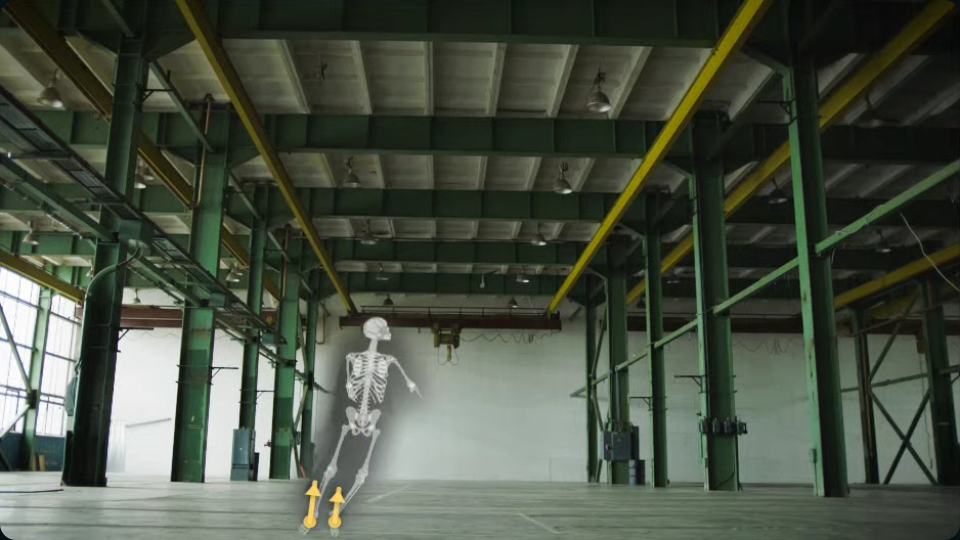
If you want a fast mental model, use this: kinematics tells you what the body did, while kinetics asks what influenced or produced that motion. Both are useful. They just answer different questions, and mixing them up is one of the easiest ways to get lost when reading movement data.
What kinematics describes
Kinematics focuses on motion itself. It deals with position, displacement, velocity, acceleration, joint angles, and angular velocities. These variables describe how a segment or a joint changes over time without requiring you to start by explaining the forces involved.
- Knee flexion angle during a squat
- Hip angular velocity during a jump
- Trunk position during a landing
- Timing of toe-off or peak flexion
What kinetics describes
Kinetics focuses on forces and moments associated with movement. In a teaching or exploratory app, these are often model-derived estimates rather than directly measured quantities. That means they can still be informative, but they should be interpreted with the right amount of caution and context.
- Estimated ground reaction force
- Estimated joint moment
- External load effects
- Power-related outputs
Why students mix them up
Part of the confusion is that both categories often appear on the same dashboard or export. A knee flexion angle curve and an estimated knee moment curve may rise and fall at similar times because they are both describing the same event. But they are not interchangeable. One describes motion. The other describes a force-related interpretation of that motion.
A squat example
Imagine a squat. If you ask how deep the athlete went, you are asking a kinematic question. If you ask when knee flexion peaked, that is also kinematics. If you ask how the estimated loading pattern changed as the subject descended and stood up, you have moved into kinetics.
This is why it helps to write the movement question before picking the signal. The question tells you whether you should start in the kinematic family or the kinetic family.
Why the distinction matters in video-based analysis
Video-derived motion analysis makes the difference even more important because the outputs do not all come from the same level of certainty. Joint angles and timing can often be reasoned about visually with the clip and overlay. Model-derived forces, moments, and power metrics usually require stronger assumptions. That does not make them useless. It simply means they should be described carefully.
How to use this distinction when reading a plot
- Ask whether the variable describes motion or force-related behavior.
- Check whether the video and fitted overlay support the interpretation.
- Use kinematic peaks to understand visible events in the movement.
- Use kinetic estimates as model-derived context, not as unquestioned ground truth.
A better way to teach it
Instead of memorizing definitions, have students pair each plot with a sentence. For example: "This knee angle curve shows when flexion increased during the descent." Or: "This estimated ground reaction force curve suggests when support demands were highest." Once students write the signal in plain language, the category usually becomes much clearer.
What to remember
- Kinematics is about motion.
- Kinetics is about forces, moments, and power-related behavior.
- Both can be useful, but they answer different questions.
- Model-derived kinetic outputs should be interpreted with appropriate caution.
- The best signal is the one that actually matches the movement question.