
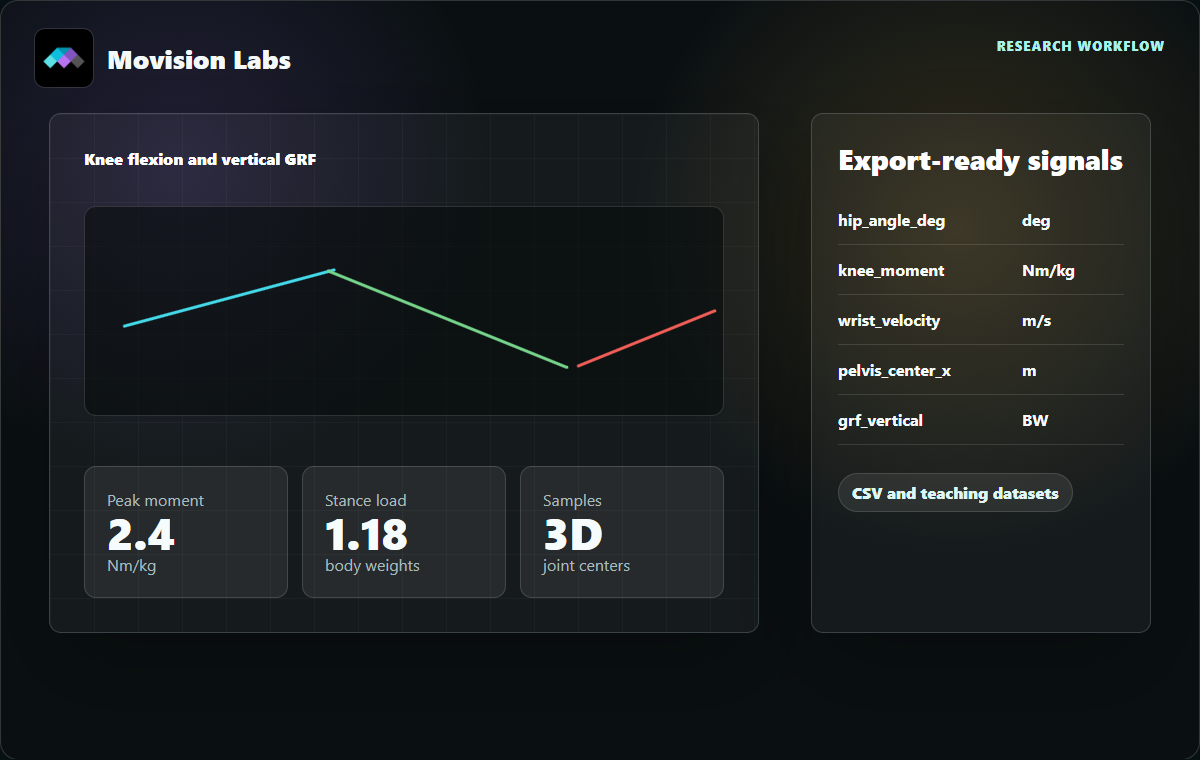
Exported signals can feel authoritative because they are tidy. They have axes, units, peaks, and decimals. But tidy is not the same thing as certain. A good interpretation starts by asking what the signal represents, what the model had to estimate in order to produce it, and whether the underlying movement was visible enough to support the conclusion.
Start with the movement question
The strongest exported plots answer a narrow question. Was the squat deeper on the second trial? Did knee flexion peak earlier? Did the landing look stiffer? Signal interpretation improves when the question comes first and the curve comes second.
Use the video, overlay, and signal together
A signal without the clip is easy to over-read. Scrub the video, check the fitted skeleton, and find the frames around the peak or transition you care about. If the body segment is partially hidden, blurred, or poorly followed by the model at that moment, that should lower your confidence in the interpretation.
Read shape before exact magnitude
For many educational and exploratory workflows, the most useful thing about a signal is its timing and overall pattern. Does it rise quickly? Flatten out? Peak earlier than expected? Change direction during a visible posture shift? Those questions are often more robust than arguing over a small difference in the absolute value.
Know which outputs are model-derived
Joint angles and segment timing are usually easier for users to reason about visually. Model-derived kinetics such as estimated ground reaction forces, joint moments, external loads, and power metrics require more care. They can be useful and informative, but they should be discussed as estimates shaped by assumptions, visibility, and model fit.
Look for consistency across trials
One exported signal can be interesting. Two or three similar trials are often much more persuasive. If a pattern shows up repeatedly under similar recording conditions, it becomes easier to separate a real movement tendency from a one-off tracking artifact or a noisy recording moment.
Use units, but do not hide behind them
Units matter because they tell you what the curve is meant to represent. They do not guarantee that the signal is the right answer to your question. A graph labeled in degrees or body weights can still be the wrong graph if the relevant segment was not visible or if the motion did not match the recording assumptions.
What to say in a good interpretation
- State what the signal represents.
- Describe when the important event happened.
- Connect the plot to the visible movement.
- Explain how confident you are and why.
- Name one limitation or uncertainty source.
What to avoid
- Do not treat a smooth curve as proof that the estimate is strong.
- Do not ignore occlusion, blur, or poor framing at the peak you care about.
- Do not describe model-derived forces or moments as directly measured unless external hardware actually measured them.
- Do not make a broad claim from a signal that was chosen after the fact just because it looked interesting.
Why this matters for students and researchers
Good biomechanics reasoning lives in the space between cynicism and overconfidence. The goal is not to distrust every plot. The goal is to read it honestly: as evidence produced by a model observing a specific recording of a real movement. That mindset scales well from classroom assignments to early-stage research workflows.