
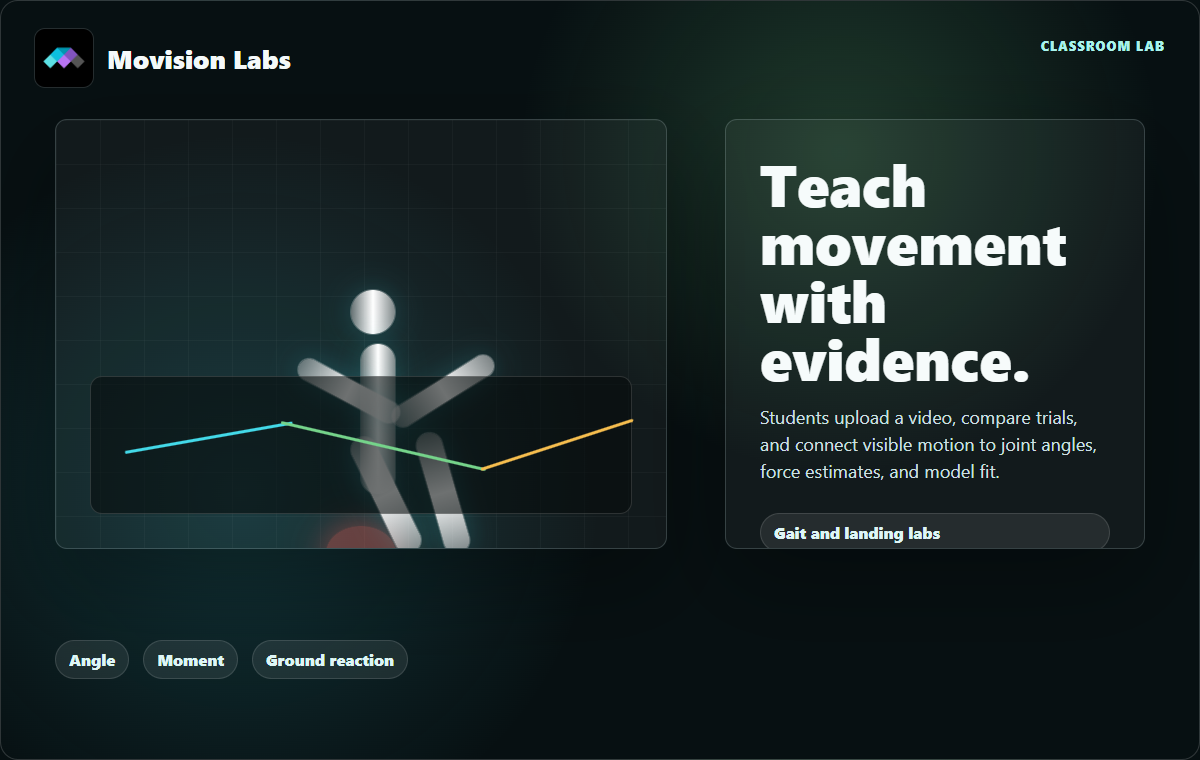
We built Movision Labs around a simple idea: visible movement should connect directly to interpretable evidence. Too many biomechanics tools start with data formats, hardware requirements, or specialist workflow assumptions. Movision Labs starts with a clip, a question, and a signal the user can inspect with context.

Connect with the founder.
Movision Labs was founded by Cole Hagen. Connect with him on LinkedIn.
Cole Hagen on LinkedInWhat the product does today
The current app lets users upload movement video, process markerless pose and fitted skeletal data, inspect movement signals, review model-derived outputs, and export images, plots, videos, and signal data for follow-up work.
Who it is built for
Students use it to connect movement to evidence, educators use it to demonstrate and structure labs, and researchers use it to move from video to exportable signals in a lightweight browser workflow.
How we talk about the science
We keep claims grounded. When a quantity is estimated or model-derived, we say so clearly. The product is positioned for education and research workflows, not diagnostic use or inflated certainty.
Why the browser matters
A browser-first tool lowers the barrier to entry. It makes it easier to use the same workflow in class, in a student project, in a lab meeting, or while teaching signal interpretation from a shared screen.
How Movision Labs is designed to be used
The strongest use cases are the ones where visual movement still stays in the loop. Users load a clip, confirm that the model fit is sensible, choose the relevant signal, interpret that signal in the context of the visible action, and then export what they need for class, reporting, or deeper analysis.
Product principles
The interface should help people understand movement, not bury them in controls or billing language.
We describe model-derived outputs carefully and avoid pretending that estimation is the same thing as direct measurement.
Students, educators, and researchers should be able to leave the app with images, videos, and data they can actually use next.